
American Trial

It was Tamir Rice’s death in 2014 that got my colleague and I to stand out in front of the college where we taught, with signs, protesting the death by police of yet another black man. 

#BlackLivesMatter had been a rallying cry for some time in cities across the country and in some smaller towns, but we felt at our community college, the students, immersed in their own struggles, needed to be reminded about a movement that was shaking up the nation. Just a few months before, Eric Garner’s last words, “I can’t breathe” had been blasted across our consciosuness. His name too was on our signs. 

A famous video had caught the horrific death of Garner as he was thrown to the ground by Officer Daniel Panteleo.Eric Garner police confrontation screenshot.PNG
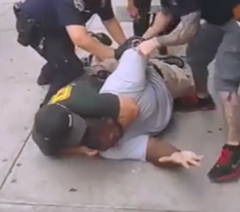
                                   A screenshot of the tackled Garner by police

It seemed impossible to believe that the Staten Island grand jury did not indict NYPD police officer Daniel Pantaleo on December 3, but then I am a white woman and have not lived with such racist attacks on my body, my family, or my community. Crowds in New York City and San Francisco gathered in protest. I joined thousands in downtown Boston who gathered on the Boston Common, and then marched in the downtown area. Many blocked traffic, trying desperately to bring America’s attention to the injustice of this.

The documentary, American Trial: The Eric Garner Story also tries to show the injustice of this time in our recent history. It calls itself “an unscripted courtroom drama” as it presents the case against NYPD officer Panteleo. It is effective in building tension, making us, the audience want a verdict of “Guilty” but it does not provide an answer. Instead after the trial, it invites the audience to make its own decision. I found this a bit unsatisfying but it’s a good marketing tool, driving an audience to decide.

If you watch the film on the 20-21st, you can vote on the verdict via online ballot here. Results will be announced May 21 during a Livestream Q&A with director Roee Messinger and Esaw Snipes Garner, Garner’s widow. Otherwise, the film has a limited run and you can find event listings here.

But in spite of its open ended approach to the trial that never happened, the documentary is worth watching. It presents an incredibly realistic trial and uses defense attorneys, retired cops, one of the medical experts who consulted on the case, a good friend of Garner’s and a very honest and heart-broken Esaw Snipes Garner. An actor, Anthony Altieri, plays Pantaleo and is fairly neutral intentionally. You don’t hate him exactly but you see how he is part of a larger system that has no interest in justice.

The documentary reminds us of the ways the criminal legal system twists words, justifies actions, and turns truth on its head so easily. Especially when it involves the life of an unarmed Black young man.

Is NYPD Officer Daniel Pantaleo guilty as charged? Is this really a question?

Today, May 20th, would have been Michael Brown’s twenty-fourth birthday. 


Hunger Strike at a Mass. Prison

Image courtesy of Change.org

A story that has not gained much coverage this week was mentioned by Michael Cox, director of policy for Black and Pink, Boston. In a press conference held by a coalition including Mass Public Health, Cox was the only participant who mentioned the strike for hunger that is occuring at North Central Correctional Instition in Gardner, Massachusetts (NCCI-Gardner).

According to Deeper than Water, a group dedicated to exposing human rights abuses in prisons, on May 5, more than 40 men refused to eat, protesting the lockdown that had been institututed by the Department of Correction (DOC) across the prison population. Carol Mici, DOC commissioner, said, as part of the Prisoners’ Legal Services’ class-action suit to decarcerate in the time of COVID-19, that she institututed the lockdown in response to the state’s “shelter-in-place order. The lockdown, as of the strike had been for 32 days, where prisoners were locked in for 23 1/2 out of 24 hours. 

Documented by Shawn Fisher of Old Colony Correctional Center (OCCC) here, and at DigBoston, the lockdown, Fisher shed light on the isolation, fear, anger and frustration for prisoners who were forced into this controversial response to the coronavirus.

Prisoners at Gardner said the food was not meeting basic needs, and refused trays slid under their door. They issued demands according to Deeper than Water

  1. Free them all. All those who currently have the power to release people (Governor Charlie Baker, DOC Commissioner Carol Mici, district attorneys, parole and probation boards, MA Department of Public Health) need to exercise their power to decarcerate immediately.

  2.  Until they are freed, provide healthier, more substantial, and more varied food options. Right now, the DOC is only offering meal options that are woefully inadequate in portion size and alarmingly high in carbohydrates and sodium content. These meals put those who are incarcerated at risk of developing or worsening chronic diseases.

  3. Until they are freed, allow those who are incarcerated time to go outside into the yard. Since April 3, prisoners at NCCI-Gardner have been locked in their units 24/7 with no fresh air. Allowing them to go into the yard once a day for 30 minutes would not present further risk of disease spread, since they would remain with the same people in their units regardless. Being able to breathe fresh air would only improve the health and well-being of those incarcerated.

After the strike began, one of the organizers, Wayland X Coleman and others were sent to the hole (solitary), possibly as punishment for the strike. As of May 7, two prisoners remained in solitary confinement including Jeremy Woodley.

Hunger strikes are in the tradition of prisoner protests when injustice is so intolerable that refusing to eat becomes the only viable option. In California in 2013, 29,000 prisoners went on strike to protest conditions in the prison including the use of solitary confinement. They did get action on their demands and ended the strike after two months.

On May 8, DOC Commissioner Mici posted a notice in all Massachusetts prisons that people who are incarcerated would be allowed back outside into the yard “starting next week.” According to Shawn Fisher, on Monday, OCCC “started letting 10 guys go to the court yard for one hour of recreation.” He had no idea if this would continue.